


Majlis Ugama Islam Singapura
Aidiladha Sermon
27 May 2026 / 10 Zulhijjah 1447H
Exploring The Wisdom Behind Acts of Worship
Blessed Muslims,
All praise belongs to Allah s.w.t., who has bestowed upon us the blessing of faith and Islam. We raise all our gratitude to Allah s.w.t., for we have been brought together on yet another day of greatness in our religion, that is Aidiladha. May it serve as a catalyst and help us to further strengthen our devotion and piety to Allah, the Lord of all worlds.
Just yesterday, millions of Muslims from around the world, including Singaporean Haj pilgrims, gathered at Arafah to fulfil the fifth pillar of Islam.
In a similar context, in the tenth (10th) year of Hijrah, the Messenger of Allah s.a.w. delivered the khutbatul wada’ or the farewell sermon at Arafah, whereupon Allah revealed verse 3 of Surah Al-Ma'idah:

Which means: “This day I have perfected for you your religion and completed My favour upon you and have approved for you Islam as religion.”
With the completion of Haj as the fifth pillar of the religion, after the Syahadah, the five obligatory daily prayers, fasting in the month of Ramadan, and the payment of Zakat, Allah conveyed His command that the religion of Islam has been perfected for the nation of His Prophet, s.a.w.
Quranic exegetes such as Imam Al-Baydawi, Ibn ‘Āshūr, and Al-Shātibi have clarified that the perfection of Islam referred to here, concerns its universal principles (kulliyyat) and foundational guidelines that direct humanity across every sphere of life.
Islam introduces principles, values, and religious foundations that determine what is lawful and what is prohibited – eternal, and relevant to all times and ages. This is the meaning of Allah's words "akmaltu lakum dīnakum” – a perfection that breathes life into the Shariah, and is neither stagnant nor rigid. Perfection in the form of principles, values, and foundational rulings, enabling Muslims wherever they may be, at any point in time, to attain understanding and navigate life with complete confidence.

Dear beloved congregation,
Among these principles and values which guarantee the endurance and effectiveness of Islamic teachings are the elements of mercy and ease that define them. This is because Allah, in His infinite knowledge, is fully aware of the limitations, changing circumstances, and challenges faced by His servants across all times. Therefore, the Shariah was not introduced to burden people, but to guide them closer to Allah s.w.t. with profound wisdom, balance, and ease. Allah s.w.t. reminds us in Surah Al-Haj, verse 78:

Which means: “He has chosen you and has not placed upon you in the religion any difficulty.”
And of His revelation in Surah al-Baqarah, verse 185:

Which means: “Allah intends for you ease and does not intend for you hardship.”
Prophet Muhammad s.a.w. also said:

Yang bermaksud: “Truly, this religion is one of ease, and no one makes the religion difficult upon themselves except that it will overcome them.” (Narrated by An-Nasa’i)
In another hadith, it is explained that whenever the Messenger of Allah s.a.w. was given two options, he would always choose the easier of the two, so long as it did not lead to sin. (Narrated by Al-Bukhari and Muslim)
Dear congregants,
This is what we can also observe in the pilgrimage of Haj. A form of worship that involves millions of people, spanning a lengthy period of time, under conditions and weather that are extremely challenging. Does the religion purposely leave its followers to face hardship and difficulty, on the grounds that all of it is merely
a test and trial of life?
The Prophet s.a.w. himself once clarified to his companions, when they faced difficulty and uncertainty in carrying out the rites of Haj:

Which means: “Just do it, and there is no harm (no sin or constraint).” (Narrated by Al-Bukhari and Muslim)
The Haj pilgrimage today is more organised and managed with strict regulation, due to the far larger number of pilgrims.
Advancements are utilised to help pilgrims perform the rites more safely and in an orderly manner. Yet these changes do not alter the essential nature of Haj itself.
This applies to many other acts of worship, including the sacrifice of korban. If in earlier times it was carried out and distributed among the local community, today it is also performed in various places across the world in order to prioritise those most in need, whilst fulfilling the spirit of the korban in assisting those who are living in hardship.
The necessary adaptation in translating religious teachings into daily life is itself a part of the Syariah. Indeed, scholars have cautioned that the ruling for any given situation must not be based solely on classical texts and writings without consideration for the lived realities of life.
Imagine – if the Syariah was bound to only one rigid and narrow form of implementation, people would surely face great difficulty in fulfilling their obligations and expressing their piety across varying circumstances. Whereas Allah s.w.t. knows that times and conditions will continue to change, and that the challenges faced by people will differ from one another.
Thus, the Syariah comes with a broadness and expansiveness that allows worship to continue to flourish in all manner of circumstances.
Blessed congregation,
It is here that we find people often falling into one of two extremes.
There are those who adopt the attitude of ifrat – being excessively rigid and inflexible to the point of rejecting any form of adaptation, as though the religion allows no room for changing circumstances. It is a mindset so narrow that it limits and diminishes what was originally a wide and spacious scope within the Syariah.
And there are also those who adopt the attitude of tafrit – belittling the rulings of the religion to the point of disregarding the clear principles and rulings that have been established by Allah s.w.t. They seek justifications without sound basis in order to permit what is clearly forbidden, simply because they wish to follow their own desires.
Whereas the path that our religion advocates is the middle path. Allah says in Surah Al-Baqarah, verse 143:
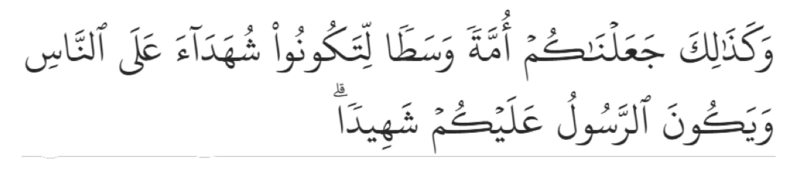
Which means: “And thus We have made you a median community, so that you may be witnesses over mankind, and so that the Messenger (Muhammad) may be a witness (of your doings) over you...”
This middle path, or wasatiyyah, does not mean compromising the principles of the religion. Wasatiyyah is itself among the principles of the religion. It is a balance that is born of a deep understanding of the perfection of the Syariah which is firm in its principles, yet wide in its application.
Dear congregation,
This balance can be seen in the life of a Muslim who understands their religion well. Such a person does not make the religion a burden, nor do they take it lightly and without principle or guidance. Rather, they make the religion a light that guides their steps in facing the changes of time.
Allah s.w.t. teaches us balance in life – in worship, in spending, in matters pertaining the permissibility of food, and in all aspects of life – so that we do not fall into either extremes.
On the basis of this understanding, Aidiladha teaches us a broader meaning of sacrifice. It is not merely the slaughtering of the sacrificial animal, but also the readiness to submit to the guidance of Allah s.w.t., even when it requires us to adapt to circumstances, without sacrificing our principles.
Thus, there are three great lessons that we must reflect upon and internalise.
Firstly: Deepening religious knowledge through a comprehensive understanding
Knowledge is not merely about knowing what is permissible and prohibited, but about understanding the purpose and wisdom behind a ruling. We need to move beyond simply asking, “Is it allowed or not allowed?”, towards broader and deeper questions such as: “What are the objectives and higher purposes (maqasid) behind this teaching?”, “What values is it seeking to realise, and how can they be practised within the realities of life without contradicting clear religious texts?”, and “What considerations be taken into account in assessing certain circumstances and situation?”
Secondly: Believing that adaptations grounded in knowledge are part of the beauty of the Syariah
Adaptation is not a weakness of the religion, but a sign of the vastness of Allah’s mercy. A community that understands this will become one that is more confident, more composed, and more resilient in facing the challenges of the times.
Thirdly: Expanding the meaning of sacrifice towards contributing to humanity
Muslims do not live only for themselves. Our sacrifices today must go beyond personal boundaries towards serving those around us and humanity as a whole. In a world facing challenges such as climate change, social tensions, and misunderstandings about Islam, Muslims must emerge as a source of mercy, wisdom, and solutions.
Dear blessed congregation,
This Aidiladha reminds us that Islam is a religion perfect in its principles, vast in its mercy, and balanced in its approach.
Let us therefore strive to become a community that is knowledgeable in understanding the religion and confident in practising it. May Allah s.w.t. make us among those whose faith is steadfast, whose understanding is sound, and whose character beautifully reflects Islam as a mercy to all creation. Amin, ya Rabbal ‘Alamin.
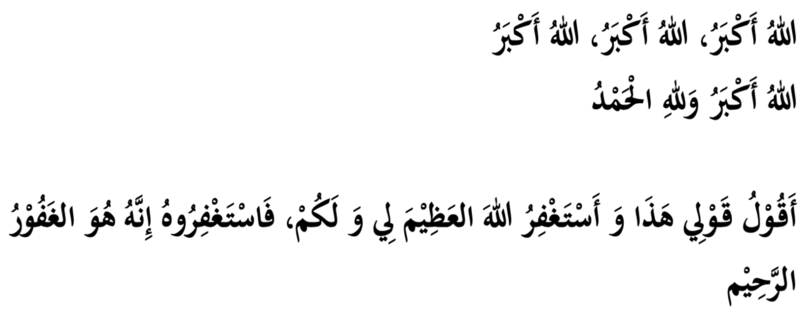
Second Sermon