


Majlis Ugama Islam Singapura
Friday Sermon
16 January 2026 / 26 Rejab 1447H
Isra’ and Mi’raj – Reflections on the Nature of Time
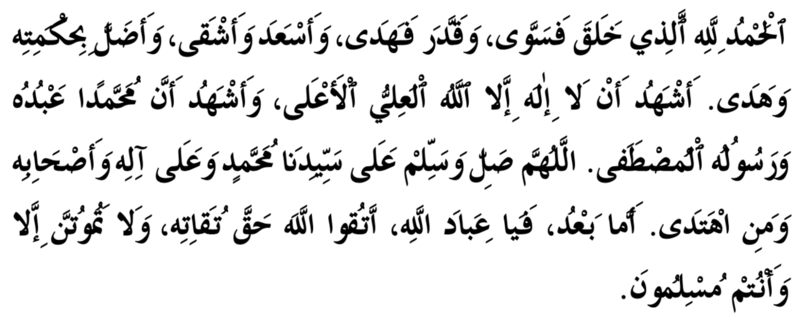
Zumratal mukminin rahimakumullah,
Have taqwa and fear Allah s.w.t. Obey all His commands and avoid all that He has forbidden. Let us open our hearts to the signs of His greatness. May our iman remain deeply anchored in our hearts until the end of our lives. Amin, ya Rabbal ‘Alamin.
Blessed congregation,
The sermon last week reflected on the importance of learning the sirah of Rasulullah s.a.w. As an extension, today’s sermon invites us to reflect on the remarkable event of Isra’ and Mi‘raj – a miraculous journey which happened in the life of Rasulullah s.a.w.
Allah s.w.t. describes this event in the opening verse of Surah Al-Isra’:

Which means: “Glory be to Him who made His servant travel by night from Masjid al-Haram to Masjid al-Aqsa, whose surroundings We have blessed, in order to show him of Our signs. Indeed, He is the All-Hearing, the All-Knowing.”
Respected congregation, the miracle that occurred during this journey was beyond ordinary human comprehension. It was so extraordinary that some people at the time rejected it entirely.
A land journey exceeding 1,500 kilometres was completed within a single night. Thereafter, Rasulullah s.a.w. was taken up to Sidratul Muntaha, passing through the seven heavens, meeting the prophets of the past, receiving the obligation of the five daily prayers directly from Allah, and then returning to Makkah – all within the same night.
Honoured congregation,
One of the reasons why this event was difficult for some to accept – apart from the vast distance – was the element of time.
Yet, while such a journey appears impossible according to human logic, it is never impossible for Allah ‘azza wa jalla.
This is the true nature of mukjizat or miracles: they reveal the limitations of human reason while displaying the absolute power and majesty of Allah s.w.t. For this reason, the verse begins with the word “Subhana” – declaring the absolute glory and greatness of Allah.
Dear congregation,
Among the profound lessons of Isra’ and Mi‘raj is the value of time. For others, that night just was like any other – a time for rest and sleep. For Rasulullah s.a.w., it was an extraordinary night, unlike any other – a night that carried countless meanings and endless guidance for the entire ummah.
As we commemorate Isra’ and Mi‘raj, the sermon calls us to reflect on two reminders regarding the value of time:
First: Every person is granted the same amount of time, but its value depends on how it is used.
Islam places great emphasis on time. Allah swears by time in many forms in the Qur’an. For example, Wal-‘Asr, Wal-Fajr, Wad-Dhuha, Wal-Lail, and many others. This is to remind us that time is a priceless blessing.
Yet how often do we say, “Time flies!” or “Ramadan is already approaching!” Moments that are still fresh in our memories, yet it turns out that many years or even decades may have passed.
Indeed, every human being is blessed with the same 24 hours each day, yet its value differs from one person to another, depending on how it is managed.
For example, as we are preparing for Ramadan, do we make time to revise our Quran memorisation or improve our recitation? Or do we delay by telling ourselves, “I’ll do it later.”
When we perform each activity with full awareness of the value of time, it can lead to significant change over the long term.
Second: Do not dwell on the past, but use the time that remains wisely.
Time that has passed will never return. But the time that remains is an opportunity not to repeat yesterday’s mistakes. Let us organise our time carefully, for time is a blessing and a resource that is beneficial only to those who manage it wisely.
Reflect also on how we spend our time online. Today, much of our time is spent on social media. Ask ourselves: Does it add real value to my faith and to my life? Or does it merely provide us entertainment, yet causes our souls to feel empty?
Beloved congregation,
In Surah Ibrahim, verses 24 and 25, Allah s.w.t. presents a powerful parable, which means: Every good deed is like a strong tree that bears fruits at all times. Each act of goodness that we plant today, no matter how small, can continue to yield benefit throughout time.
May Allah s.w.t. make us among His servants who value time, so that we may attain success in this world and the Hereafter. Amin, ya Rabbal ‘Alamin.

Second Sermon
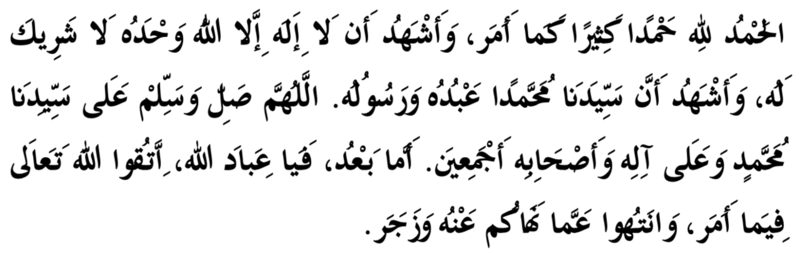
Dear blessed congregation,
Without us realising it, nearly three years have passed with our brothers and sisters in Gaza suffering under severe oppression. Although distance separates us, we are still able to support them through our prayers and our collective efforts.
Recently, the Rahmatan Lil Alamin Foundation launched the “Aid for Gaza” campaign to assist the community there. This campaign, which will continue until 31st March this year, aims to set up basic facilities such as shelters, health clinics, and community kitchens.
Let us extend our help according to our ability as a sign of mercy (rahmah) and compassion (ihsan). May Allah lift every hardship and restore peace for all. Amin, ya Rabbal ‘Alamin.