


Majlis Ugama Islam Singapura
Friday Sermon
17 April 2026 / 28 Syawal 1447H
Lessons from the Islamic Tradition of Knowledge
Zumratal mukminin rahimakumullah,
Let us observe taqwa towards Allah s.w.t., obey all His commands and refrain from all that He has prohibited. May the taqwa we carry today be rewarded with His pleasure when we stand before Him in the hereafter. Amin, ya Rabbal ‘Alamin.
Dear blessed congregation,
We are living in a time where change, driven by advances in science and technology, is unfolding faster than ever, transforming both our lifestyle and our religiosity in ways once unimaginable. Brothers, this change will only continue. And alongside this progress come increasingly complex challenges in matters of religion; challenges that demand an equally advanced grasp of knowledge.
In seeking guidance to navigate today’s complexities, we must reflect on the Islamic tradition of knowledge. This tradition produced some of the greatest minds the world has seen such as Al-Khawarizmi, Ibn Sina, and Al-Biruni, and many others whose contributions in fields like mathematics, medicine, and astronomy continue to benefit humanity today. This lasting impact invites us to reflect on how such excellence was achieved.
Dear brothers,
There is an abundance of lessons we may derive from the Islamic tradition of knowledge and the scholars it produced.
From these lessons, we will focus on three that are significant.
Firstly: Seeking knowledge empowers us
Knowledge equips us with the intellect and wisdom needed to navigate life and its complexities. Even now, new discoveries and narratives are already challenging our existing perceptions and stances on certain religious issues. It is for this reason that acquiring the right knowledge has become fardhu ‘ain; a personal religious obligation, for each and every one of us today.
This message is especially important for the youth, who have the energy and zeal to actively seek knowledge. At the same time, for those whose youthful drive may have lessened, we are reminded that while energy may fade, time remains. Allah s.w.t says in Surah al-Mujadilah, verse 11 which means:
“…Allah will elevate those of you who are faithful, and raise those who have knowledge in rank. And Allah is All-Aware of what you do.” So, while there is still the opportunity to seek knowledge, let us strive to seek it so that we may better understand and practise His religion, and raise our ranks.
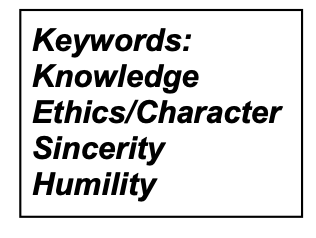
Secondly: Knowledge must be paired with ethics, sincerity, and humility.
In Islam, knowledge and good character go hand in hand. It is not enough to simply know a lot. True knowledge is the one that shapes our ethics, positively changes how we act, and guides how we treat others.
Further, knowledge must be paired with sincerity; doing what we know to be right, not to impress others, but purely for the sake of Allah. When knowledge and sincerity walk together, that is when we truly begin to grow.
Without these values, knowledge loses its purpose and may even become harmful. When knowledge is detached from sincerity and humility, it can lead to arrogance, self-importance, and the misuse of information to pursue personal gain or agendas.
Importantly, even when knowledge brings worldly advantages, including monetary rewards, we must be reminded that these are only secondary benefits. If pursued as the sole objective, know that it reflects distorted intentions, and such intentions risk compromising ethical considerations. And what was meant to be a source of guidance then becomes a tool of confusion and division. This is why Islam links knowledge with khasyah; fear and awe of Allah s.w.t.
Allah s.w.t. says in Surah Fatir, verse 28:

Which means: “Just as people, living beings and cattle are of various colours as well. Of all of Allah’s servants, only the knowledgeable truly observe khasyah; awe and fear of Him. Indeed, Allah is The Almighty, All-Forgiving.”
Blessed congregation,
This verse calls us to ensure that learning is always anchored in the awareness of Allah, and the sincerity of learning for Him.
The scholars of the past embodied this. Their vast learning was accompanied by deep sincerity, humility, fear and awe of Allah, and a strong sense of responsibility towards the community.
They did not seek knowledge for status but for closeness to Allah and service to others. It is this balance that gave their knowledge its lasting impact and barakah; blessings.
Therefore, as we pursue knowledge, we must remember that its true value lies in how it refines our character and strengthens our relationship with Allah s.w.t. Knowledge without ethics is
incomplete, but knowledge grounded in sincerity, humility, and good character becomes a guiding light not only to ourselves, but to those around us as well.
Thirdly: Knowledge must be lived and succeeded
Knowledge in Islam is not meant to remain as information, but to be lived through action and character. When a person sincerely applies what they know, knowledge becomes real, meaningful, and transformative. It is through living knowledge that it truly takes root in the heart and is given life.
This is also the most effective way to pass knowledge down. Before words are spoken, actions are observed. Consistent practice of values, faith, and good character leaves a deeper and more lasting impact than instruction alone. This is why knowledge is best transmitted when it is embodied.
Blessed congregation,
Let us strive to be among those whose knowledge leads to sincerity, humility, and righteous action. May our knowledge bring us closer to Allah, increase both our fear and love of Him, refine our character and contribute to the betterment of our society. And may Allah s.w.t. make us among those who act upon what they know. Amin, ya Rabbal ‘Alamin.

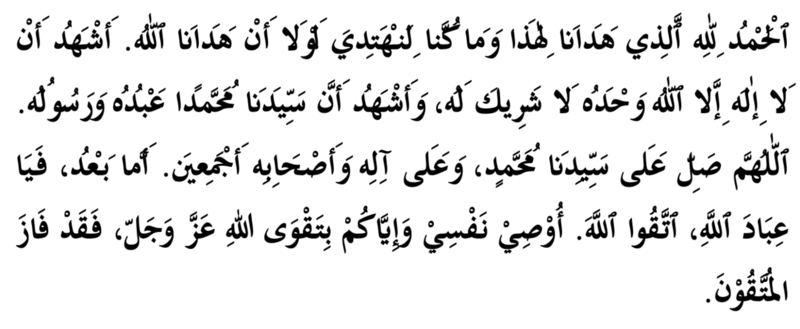
Second Sermon