


Majlis Ugama Islam Singapura
Friday Sermon
20 February 2026 / 2 Ramadan 1447H
Ramadan: Towards a Believer’s Transformation
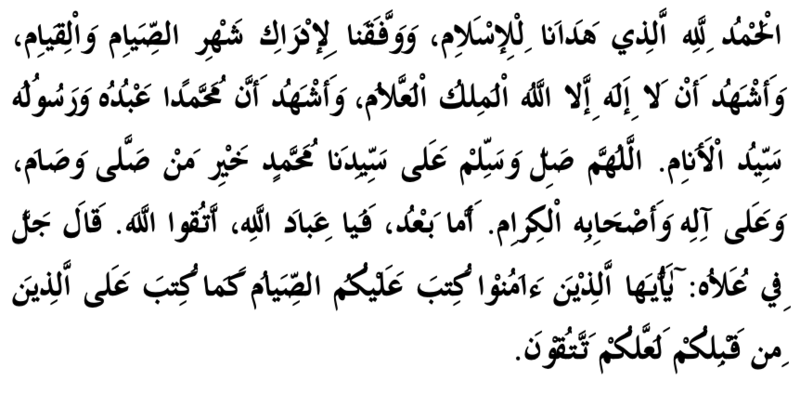
Zumratal mukminin rahimakumullah,
Have taqwa towards Allah s.w.t. with true consciousness. Let us strengthen our taqwa as we embrace this blessed month of Ramadan. May we be among those who truly have taqwa in the sight of Allah s.w.t.
Dear blessed congregants,
We are alive and breathing today, in this Ramadan, even though there is no guarantee that we will see another day. Indeed, this is a tremendous blessing from Allah, another golden opportunity for us to attain lasting success in the sight of Rabbul ‘Izzah.
Let us aim to make this Ramadan the best Ramadan we have ever experienced. A Ramadan that will weigh heavily on the scale of our deeds, and elevate both the quality and quantity of our worship to the vastness of the heavens and the earth.
Yes my brothers, as vast as the heavens and the earth, if it is truly maximised by believers whose hearts are awakened – just as described by the Prophet s.a.w. in an authentic hadith narrated by Ibn Majah.
My dear brothers,
At the beginning of Ramadan, many of us are still adjusting – abstaining from food and drink during the day, under the heat of the sun. Indeed, fasting requires patience. The Prophet s.a.w. said in a hadith narrated by Imam At-Tirmizi, which means:
“Fasting is half of patience.”
What is the relationship between fasting and patience? To understand this, let us reflect on the explanation of a great scholar, Abū ‘Abdillāh al-Ḥalīmī asy-Syāfi’ī, who lived in the fourth century of Hijrah. In his book, al-Minhāj fī Syu’ab al-Īmān, he explained that every act of worship involves two aspects: doing something and refraining from something.
When a person fasts, he restrains his carnal desires and impulses – this is one form of patience. And when he strives to fulfil the commands and perform the obligations set by Allah, that is another form of patience.
From this, we may conclude that Ramadan is a month of training our patience. During the day, we are trained to restrain ourselves from eating, drinking, and anything that invalidates our fast. At night, we are also trained to be patient in filling our time with acts of worship, such as reciting the Qur’an and performing night prayers (qiyamullail).
Here lies the potential of Ramadan as a catalyst for spiritual transformation. This can be achieved by two ways:
First: Cultivating a Sense of Responsibility
Fasting trains us to be more mindful and responsible, with full awareness that Allah s.w.t. knows our every action.
My dear brothers, during the daytime in Ramadan, we restrain ourselves from things that break our fast, such as food placed right before our eyes, even though it is lawful or halal. If we reflect upon this, should this not make it easier for us to abandon what is clearly forbidden or haram?
The discipline of patience should help us manage our desires, such as anger, extravagance, and harmful greed. Let us not allow only our stomachs to feel hunger, while our uncontrolled desires remain full and satiated.
Second: Refining Our Outward Character
The patience cultivated through fasting should make us more careful in our speech and conduct. We become more mindful in our words, we do not respond to evil with evil, and we do not spread unverified information that may lead to slander.
Ramadan teaches us to practise patience in every interaction, to build empathy, and to prioritise goodness in every relationship.
Through this, our outward character becomes a reflection of pure faith. It is not confined to personal acts of worship alone, but is manifested in our manners and behaviour. These are the qualities of true believers.
Esteemed congregants,
Let us journey through this Ramadan with full awareness of faith. Not merely by enduring hunger and thirst, but by focusing on self-transformation and continuous improvement. May Allah s.w.t. forgive our sins, and bless our lives and our deeds.
Second Sermon