


I have no heirs. What happens to my estate under faraid?
In brief:
- • If a Muslim in Singapore passes away without any rightful faraid beneficiaries, their estate will go to Baitulmal, administered by the Islamic Religious Council of Singapore (MUIS).
- • Islamic legacy planning tools such as wasiat (Muslim will), CPF nominations and insurance nominations, can help you make provisions for loved ones who may not inherit under faraid, as well as causes you care about.
"I'm widowed with no children. I don't have the typical heirs. Who gets my wealth when I'm gone?"
"I have a wife and daughters but no son. My brothers will get a share. Can I do anything about that?"
"I only want to give to certain people. Is that allowed?"
These are not abstract questions. They come from real people facing real family situations: converts whose parents are non-Muslim, individuals who raised stepchildren as their own, widows with no surviving close relatives, and people who simply want a say in where their wealth goes. And increasingly, they come from people who want to do more than provide for their family. They want their wealth to continue doing good long after they are gone.
Faraid has a clear answer for what happens to our estate by default. But Islam also provides us with ways to plan beyond faraid - for the people we love and the community we belong to.
| 📝Find out more about Islamic Legacy Planning on MUIS website. |
What happens under faraid if you have no heirs?
Faraid is the Islamic inheritance system, grounded in the Quran and hadith. It determines who inherits a deceased Muslim’s estate and the share each rightful heir receives. In Singapore, faraid is legally enforced under the Administration of Muslim Law Act (AMLA), Sections 110–112. It distributes the estate according to a fixed hierarchy that includes spouses, children, parents, siblings, and extended family, with each heir's share precisely defined.
But what happens when none of these heirs exist, or when there is a residual portion after all shares have been distributed? Under the Shafi'i school of thought applied in Singapore, the remainder goes to Baitulmal, the community endowment fund administered by MUIS under AMLA Sections 57, 58(1) and 59. Baitulmal receives the estate in four situations:
• when there are no rightful faraid beneficiaries;
• when there is a residuary portion after distribution;
• when the estate is unclaimed; or
• when the deceased leaves no surviving lawful beneficiary.
Baitulmal is considered an amal jaariyah; a continuous good deed that benefits the deceased by supporting the Muslim community. For many people, learning this becomes a moment of quiet reflection; a reminder that planning our legacy is itself an act of care, for the people we love and the causes we hold dear.
Who cannot inherit under faraid?
Not everyone we love or care about will necessarily be recognised as a faraid heir. Non-Muslim family members cannot inherit from a Muslim estate. This is based on the hadith:
"A Muslim does not inherit from a non-Muslim, and a non-Muslim does not inherit from a Muslim."
(Sahih Muslim)
Adopted children are also not recognised as heirs under faraid, as adoption does not create blood ties for inheritance purposes. Stepchildren, children born out of wedlock, close friends and charities also fall outside the faraid framework.
Faraid reflects how Islam teaches us inheritance in the most systematic of ways, while planning through wasiat (Muslim will) and hibah (gift) teaches us compassion and intention beyond that system. This does not mean we cannot make provisions for the people and causes that matter to us. This is where Islamic legacy planning becomes important.
Can you leave your estate to someone who is not a faraid heir?
There are several tools that can help Muslims in Singapore plan for loved ones who may not be faraid beneficiaries.
1. Wasiat (Muslim will)
Through a wasiat, you can direct up to one-third of your net estate to someone who is not a faraid heir - a non-Muslim parent, an adopted child, a stepchild, a close friend, or a charitable or religious cause. The remaining two-thirds must follow faraid unless all rightful heirs give their consent.
2. CPF nomination
Your CPF nomination, recognised as a contemporary form of hibah under the MUIS 2010 Fatwa, goes directly to your chosen nominee and is outside faraid.
3. Insurance nomination
A revocable insurance nomination is similarly recognised as a form of hibah. It is considered a gift nominated during your lifetime and is therefore not subject to faraid distribution.
These tools allow you to plan intentionally for people who matter to you while ensuring that your arrangements remain aligned with Islamic principles.
Planning for the community around you
Legacy planning does not have to stop with our family. And this is where many of us stop short.
We plan for our children, spouses and the people we know and love. But there is an aspect of legacy that Islam encourages us into - one that reaches far beyond those we call our own. It is the aspect of sadaqah jaariyah: the deed that continues after we pass on.
Prophet Muhammad s.a.w. said: "When a person dies, all their deeds come to an end except for three: ongoing charity (sadaqah jaariyah), beneficial knowledge, and a righteous child who prays for them." (Sahih Muslim)
Sadaqah jaariyah offers us the possibility that our good deeds do not have to end with our last breath. We can plant something today that continues to benefit others, and earn us rewards, long after we are gone.
One way to create sadaqah jaariyah is through wakaf, an Islamic endowment that provides perpetual benefits. Unlike a one-time donation, wakaf creates a sustainable source of funding that continues to generate returns and support causes indefinitely
Think about the mosques and madrasahs that have shaped your life. The mosque where you first learned to pray. The madrasah where a teacher's words stayed with you for decades. The community programmes that held your family together during difficult times. These institutions did not appear from nowhere. They were built, sustained, and protected by Muslims who came before us - people who chose to make their wealth an act of worship that outlasted them.
Our forefathers have shown this. They did not wait until they had more. They gave what they had, with intention, and trusted Allah s.w.t. to multiply it. For example, wakaf Masjid Omar Kampong Melaka, established in 1820, is the first recorded wakaf in Singapore. Wakaf Jamae, established in 1825, continues to benefit Jamae Chulia Mosque and Al-Abrar Mosque today. The Muslims who established these wakaf are long gone. But their sadaqah jaariyah is still flowing. The mosques still benefit thousands that came after them.
Today, we too can choose to leave something behind that continues to benefit others.
Your choice: Mosque, madrasah, or wakaf
Your legacy gift helps build a stronger, more resilient community by providing sustainable funding for mosques and madrasahs, supporting the development of asatizah, enabling socio-religious programmes that uplift the Muslim community, and ensuring Islamic institutions can continue serving the community.
You can plan your legacy giving through your CPF nomination, insurance nomination or wasiat. Through these tools, you can designate a portion of your wealth to a mosque, a madrasah, or wakaf of your choice as an act of sadaqah jaariyah.
The choice is entirely yours. Give intentionally to the institution or cause that has shaped your life and your faith. Perhaps it is the mosque where you found peace during the hardest year of your life. Perhaps it is the madrasah that gave your child a foundation in their religious life. Or perhaps it is a wakaf that will serve generations of Muslims you may never meet but whose lives your wealth will quietly touch. The amount does not matter. There is no minimum in sadaqah jaariyah. Your name may never be emblazoned on a building. But every deed, as small as an atom, is seen and recorded in the eyes of Allah s.w.t.
We will all leave this world with our hands empty. The only question is whether we choose, while we still have the chance, to send something ahead.
Case study: A family left without a plan
Consider Ahmad, a Muslim convert who passed away suddenly without a CPF nomination, insurance nomination or wasiat. He left behind his wife, two young daughters and his elderly non-Muslim parents who had raised him with love. Under faraid, his wife received 12.5% of his estate, his daughters received 66.7%, and the remaining 20.8% went to Baitulmal. His parents - despite their sacrifices - received nothing, because non-Muslims cannot inherit under faraid
Had Ahmad made a wasiat directing one-third of his estate to his parents, or nominated his CPF savings to them, he could have made provisions for them. And had he wished to leave something for his mosque or a cause he believed in, he could have planned for that too. Islamic legacy planning tools exist for this very purpose: to ensure that everyone we leave behind is provided for, and that the wealth we leave behind continues to do good.
How can Muslims in Singapore start legacy planning?
Whatever your family circumstances, planning ahead can help you provide for the people you care about and leave a meaningful legacy beyond your lifetime. Here are some steps you can take:
1. Know your faraid heirs at go.gov.sg/faraidcalculator.
2. Draft or update your wasiat by learning more at go.gov.sg/planmywasiat.
3. Make your CPF and insurance nominations.
4. Consider legacy giving. If you wish to extend your legacy beyond your family to a mosque, madrasah, or wakaf of your choice, visit go.gov.sg/givelater.
5. Notify MUIS of your intended beneficiaries via go.gov.sg/muisnomination. The funds will be disbursed to the selected MUIS entity in accordance with your wishes upon your demise.
Allah s.w.t. says:
"The example of those who spend their wealth in the cause of Allah is that of a grain that sprouts into seven ears, each bearing one hundred grains. And Allah multiplies the reward even more to whoever He wills. For Allah is All-Bountiful, All-Knowing."
(Surah al-Baqarah: 261)
You get to decide what is left behind. But only if you plan.
Take the next step in your Islamic legacy planning
Whether you are just starting out or ready to take action, our upcoming Islamic Legacy Planning (ILP) Village has something for everyone.
Hear from the experts first
Join our Community Forum, Dari Harta Puaka ke Harta Pusaka: Turning Inheritance Curse to Family Legacy, where religious and legal experts unpack the real consequences of incomplete planning, using relatable stories drawn from the Mediacorp microdrama Remuk: Yang Tinggal. Walk away knowing exactly what your family needs to discuss, document and review, before it is too late.
For professionals in the legal, financial, religious or estate planning space, the Practitioners' Network Forum, Connecting Practice, Sharing Insights, brings together 500 practitioners for a structured, facilitated dialogue to build shared understanding and strengthen cross-disciplinary collaboration across the ILP ecosystem.
Then, complete your planning on the same day
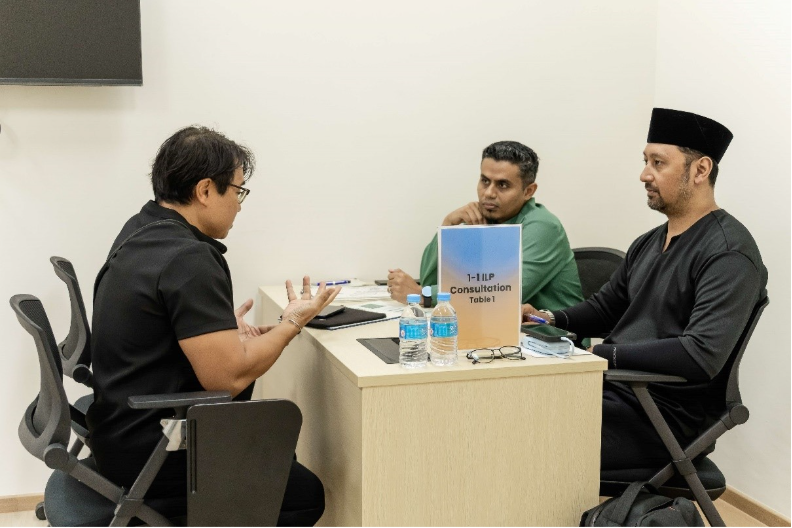
Stay on for the ILPV Marketplace, where our experts will guide you through CPF and Insurance Nominations, Legacy Giving, LPA Certification, MyACP and personalised Islamic Legacy Planning Consultations, all in one place. These are among the amanah (trust) we ought to fulfil as provisions towards a life well-lived and a blessed end.
📅 Saturday, 7 November 2026 | 10:00 AM – 6:00 PM
📍 Woodlands CC
• Register your interest at go.gov.sg/ilpv-interest
Articles on MuslimSG may be reproduced electronically or in print with prior permission from MuslimSG. Proper credit must be given to the author(s) and MuslimSG.