


Is consuming rare steak halal?
This article has been vetted by ARS certified asatizah.
| Sections: The Islamic ruling on blood | What is the red juice that oozes from your rare steak? | Halal perspective on consuming rare steak | Enjoying halal steak at home | No mistake about your steak |
The Islamic ruling on blood
Allah s.w.t. says in the Quran:
حُرِّمَتْ عَلَيْكُمُ ٱلْمَيْتَةُ وَٱلدَّمُ وَلَحْمُ ٱلْخِنزِيرِ وَمَآ أُهِلَّ لِغَيْرِ ٱللَّهِ بِهِۦ
"Forbidden to you (for food) are: dead meat, blood, the flesh of swine, and that on which has been invoked the name of other than Allah."
(Surah Al-Ma'idah, 5:3)
This verse clearly prohibits the consumption of blood. During halal slaughter (dhabh), the jugular veins, windpipe, and carotid arteries in the animal's throat are cut swiftly while invoking the name of Allah. This process allows most of the blood to drain out, as required by Islamic law.
Therefore, meat from halal animals that have been properly slaughtered and drained of its blood, according to the conditions and rulings of Islamic law, is halal.
What is the red juice that oozes from your rare steak?
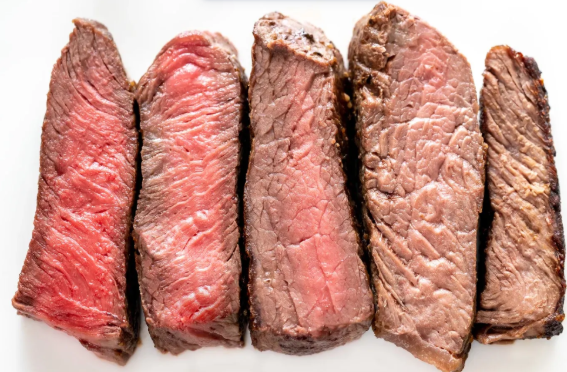
You might wonder, is the blood from a rare steak halal? Well, if it were actually blood, it wouldn’t be halal. Contrary to common belief, the red liquid in your steak, which appears especially when served rare, isn't blood. It's primarily water mixed with a protein called myoglobin, which is naturally found in muscle. Myoglobin stores oxygen for the muscle's own use, similar to how haemoglobin carries oxygen in the blood for circulation throughout the body.
Myoglobin is what gives meat its colour. When raw or lightly cooked, myoglobin appears red. As meat cooks at higher temperatures, myoglobin changes colour and turns brown. This is why well-done steak is brown throughout while rare steak has a red centre.
The level of doneness affects not only the colour but also the steak's texture and juiciness. Importantly, the redness you see in a rare or medium steak is simply oxygenated myoglobin, not undrained blood. The actual blood has already been removed during halal slaughter.
Halal perspective on consuming rare steak
Since myoglobin is part of the muscle tissue and isn’t actual blood, it doesn't make the meat haram. This means your steak is permissible to eat at any level of doneness, whether rare, medium, or well-done, as long as:
1. The meat is from an animal that is halal for consumption
2. The animal was slaughtered according to Islamic law, ensuring that blood was properly drained in the process
3. There are no haram ingredients added to the preparation
Enjoying halal steak at home
If you're planning a steak dinner at home, start by sourcing halal meat. Look for a halal logo on the packaging. Once you have it, you can cook your steak to whichever doneness you prefer.
Not in the mood to cook? Find halal steakhouses near you using the Muslim.sg app. Just download it for free and head to the 'Halal Makan Places' section.

No mistake about your steak
The misconception that rare steak is haram is simply a case of mistaken identity. People confuse myoglobin with blood. Myoglobin is a natural muscle pigment, not a forbidden substance. Proper halal slaughter ensures that the actual blood is removed, making cooked halal meat permissible for consumption regardless of doneness.
So next time you're at a halal steakhouse, don't worry about ordering that medium-rare steak!
References
1 2013. Suman, S. P., & Joseph, P. Myoglobin Chemistry and Meat Color. Annual Review of Food Science and Technology, Volume 4.
2 2023. American Meat Science Association. Chemistry of Fresh Meat Color.
Articles on Muslim.Sg may be reproduced electronically or in print with prior permission from Muslim.Sg. Proper credit must be given to the author(s) and Muslim.Sg.